Field Notes
The Effort Economy of AI Slop
AI didn't just make content easier to create. It made it almost impossible to escape.
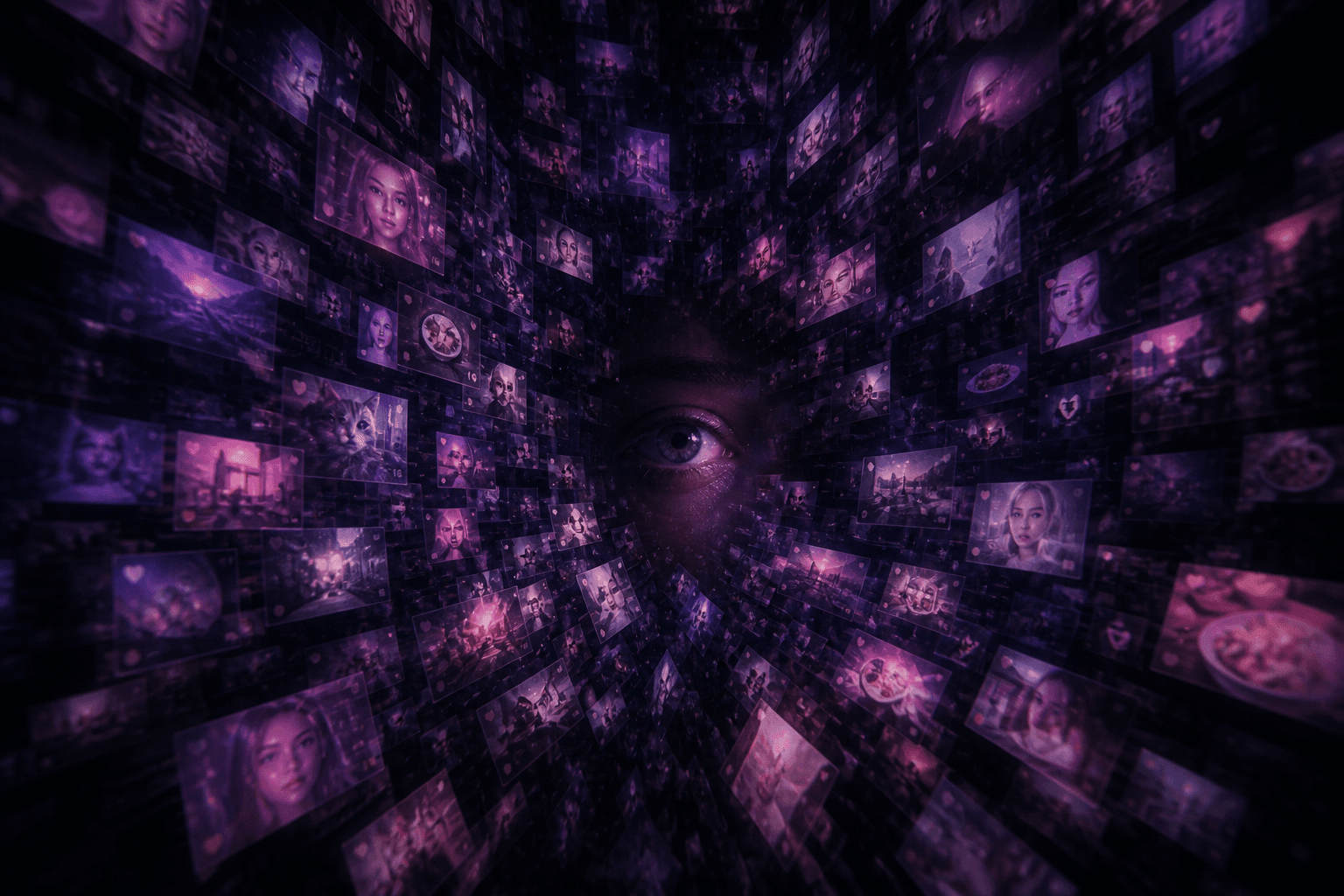
A strange moment across the internet
AI didn't just make content easier to create. It made it almost impossible to escape.
There is a strange moment happening across the internet. The companies that spent the last few years encouraging us to create more with AI are now trying to figure out how to stop the internet from filling up with what we've started calling AI slop.
Spotify removed 75 million spam tracks over a 12-month period. TikTok says it has labelled more than 3 billion AI-generated videos, while YouTube and other platforms are increasingly targeting low-quality, repetitive AI content.
And this isn't some fringe problem. Kapwing manually analysed 10,742 TikTok videos across 20 categories and found that 59% of the videos served to a brand-new account's For You page were AI slop. In the kids category, the proportion was even higher.
So how did we get here?
AI is actually very good for content
Before getting into the slop, it is worth separating the technology from the problem.
AI can be genuinely useful for creators. It can turn an idea into a first draft, generate subtitles, remove unwanted sections from a video, create images, help with research or take care of repetitive editing work.
For smaller creators, those are meaningful advantages. A person who previously needed a designer, editor or copywriter for certain tasks can now do much more themselves, often at a fraction of the cost.
That is a genuinely exciting development. Lowering the cost of creation means more people can experiment and make things they couldn't previously afford or didn't have the technical skills to produce.
Adobe's 2026 Creators' Toolkit Report found that 87% of surveyed creators said creative AI was helping them grow their business or audience.
Once production gets this cheap, though, the incentive changes.
Why stop at one piece of content when you can make ten?
When content became almost free
Slop is something that takes more human effort to consume than it took to produce.
For most of the history of the internet, making content required some amount of effort. Someone had to write it, edit it, design it, record it or at least spend enough time thinking about it to decide whether it was worth publishing.
Production is only one side of the system.
Someone still has to consume what gets produced. They have to read it, watch it, evaluate it, decide whether it is useful, check whether it is true and work out whether they should trust it.
This is the idea Leon Furze captures in his "effort economy of slop." His definition, originally attributed to Simon Willison, is simple: slop is something that takes more human effort to consume than it took to produce.
The economics are lopsided. The producer gets faster; the consumer still has roughly the same amount of time to sort through everything that arrives.
The platform paradox
The platforms had good reason to welcome the flood at first.
More content means more things to discover. More posts can mean more engagement. More videos can mean more watch time and, ultimately, more revenue.
AI made it dramatically easier to feed those systems. Meta has described AI as enabling an "explosion of new media formats", while YouTube has said that more than one million channels used its AI creation tools in December alone.
There is nothing inherently wrong with that. Platforms want creators to have better tools, creators want better tools, and users benefit when those tools help someone make something genuinely interesting.
Things get messy when the same economics are used to produce millions of things that nobody particularly wanted.
The engagement trap
AI slop was initially a "double-edged sword" for platforms because it could generate upticks in engagement, according to AI researcher Paul Shovlin, quoted by The Indian Express. But as the volume increased, users had a harder time finding the content they actually wanted.
The algorithm doesn't necessarily understand that something is slop. It sees that people are clicking on it, watching it or sharing it.
A bizarre AI-generated image can receive nearly one million likes on Facebook. Kapwing estimated that one YouTube slop channel was generating $4.25 million a year before it was suspended from the platform's monetisation programme.
From the platform's perspective, engagement is a useful signal. From the user's perspective, that same engagement can be evidence that the feed is becoming harder to navigate.
Eventually, those interests stop lining up.
That's when the cleanup begins
Detecting AI isn't enough.
We're now seeing platforms move from simply enabling AI creation to actively managing its consequences.
Spotify is introducing "AI persona" labels while excluding those artists from personalised recommendations by default. LinkedIn has introduced a way for users to report AI slop. Pinterest is giving users more control over AI-generated content in their feeds, while YouTube is targeting low-quality, repetitive AI content. Meta is also prioritising original content in Feed and Reels and reducing the reach of unoriginal material.
Platforms still want AI creation. What they're trying to suppress is the flood of low-value content that follows it.
AI isn't the defining characteristic of slop
A piece of content doesn't become bad simply because AI touched it.
A human can make terrible content, and an AI-assisted piece can be thoughtful, original and genuinely useful.
Christian Schaffner makes a similar argument from a design perspective: the problem isn't simply that AI generated something. It is what happens when nobody takes responsibility for shaping the final result, editing it down or deciding what actually matters.
That distinction matters.
A filmmaker might use AI to storyboard a scene. An editor might use it to remove hours of repetitive work. A creator might use it to explore ten ideas before choosing one.
The final piece can still reflect human judgment, taste and intent.
The trouble starts when the ability to produce something cheaply becomes a reason to produce it without asking whether it deserves to exist.
The human creator has a problem too
This isn't doing genuine human creators any favours either. When content becomes incredibly cheap to produce, good content has to compete against an enormous amount of it.
A creator who spends days making an original video can now find themselves competing for attention with someone who can generate fifty variations overnight.
The AI creator doesn't necessarily win. But the volume changes the environment in which everyone is trying to be discovered.
There is a flip side.
If feeds become increasingly crowded with generic, synthetic content and engagement bait, genuinely original creators may become easier to value precisely because they feel different.
Audiences may start placing more weight on recognisable voices, personal experience, credibility and the sense that someone actually cared about what they were making.
People may be perfectly comfortable with AI as a tool. What they increasingly want to know is what the tool actually did.
Did AI help edit this? Did it write it? Create the image? Generate the person? Produce the entire account?
Those are very different levels of involvement.
And that creates an interesting tension: AI may make it harder for human creators to get noticed in the short term while making human originality more valuable in the long term.
We're moving from an abundance problem to a trust problem
The first wave of generative AI was largely about capability.
Can it write? Can it draw? Can it make video? Can it clone a voice?
Now that the technology can do all of those things well enough, we're left with a harder question: which of these things deserve my attention?
When content was expensive to create, effort acted as a rough filter. It wasn't perfect, but producing something still required enough time and energy to limit how much any individual could put into the world.
AI removes much of that friction.
Someone still has to do the filtering: the consumer, the platform, the recommendation algorithm or the creator themselves.
Increasingly, it will probably be some combination of all four.
The strange economics of abundance
Generative AI is making creation faster, cheaper and more accessible.
But if everyone can create ten times more content, we don't necessarily get ten times more value.
We get ten times more things competing for the same human attention.
Attention hasn't become any cheaper. Neither has time, and neither has trust.
That changes what becomes valuable.
Curation matters. Taste matters. Originality matters. So does having a recognisable point of view and knowing when something isn't worth publishing.
For the creator, the cost of producing another piece of content is falling rapidly.
For the consumer, the cost of evaluating another piece hasn't changed much at all.
The cost has simply moved.
Someone still has to decide:
- Is this worth watching?
- Is this actually useful?
- Is it original?
- Is it true?
- Do I trust the person who made it?
The platforms have a new problem to manage
Optimising for more content and optimising for a better content ecosystem aren't always the same thing.
From a technology strategy perspective, embracing generative AI wasn't necessarily a mistake.
Platforms saw a technology that could make creation easier, increase supply and create new formats. That's exactly the kind of technology worth experimenting with.
There is a point at which additional supply stops creating value and starts degrading the product.
The platforms are now discovering where that point is.
So they're building detection systems, introducing labels, changing recommendation algorithms, giving users controls, removing spam and prioritising original content.
They're adding a new layer of infrastructure to manage the abundance that their own technology helped create.
That's what happens when a technology changes the underlying economics of a system.
The system has to adapt.
So what happens next?
That doesn't mean everything needs to exist.
We're not heading toward an internet where AI-generated content disappears.
AI will become a normal part of how almost everything is created.
Writers will use it for research and drafts. Designers will use it for exploration. Editors will use it for repetitive work. Creators will use it to produce things that would otherwise be impossible or unaffordable.
That's the good part.
The challenge is building an information environment where more creation doesn't automatically mean more noise.
That will probably require better provenance, clearer disclosure, smarter recommendation systems and stronger incentives for originality.
It may also require something less technical: becoming better at recognising the value of the person behind the work.
Because the real problem with infinite content isn't that there is too much to create.
It's that there is still only so much any of us can pay attention to.
AI can generate ten versions of an idea in seconds. It can make a video, write a caption, create a thumbnail and publish all of them before a human has even decided whether the original idea was interesting.
It can lower the cost of making something.
It can't lower the cost of caring about it.
AI will make it easier to create almost anything.
As the cost of producing content approaches zero, the advantage shifts toward something much harder to manufacture at scale: a reason for someone to stop, pay attention and remember what they just saw.
The next phase of the internet won't just be about who can create the most.
It will be about who can create something worth making.