Field Notes
Humans Inside the Test Tube
What happens when an emerging technology moves from laboratory experiment to industry infrastructure?
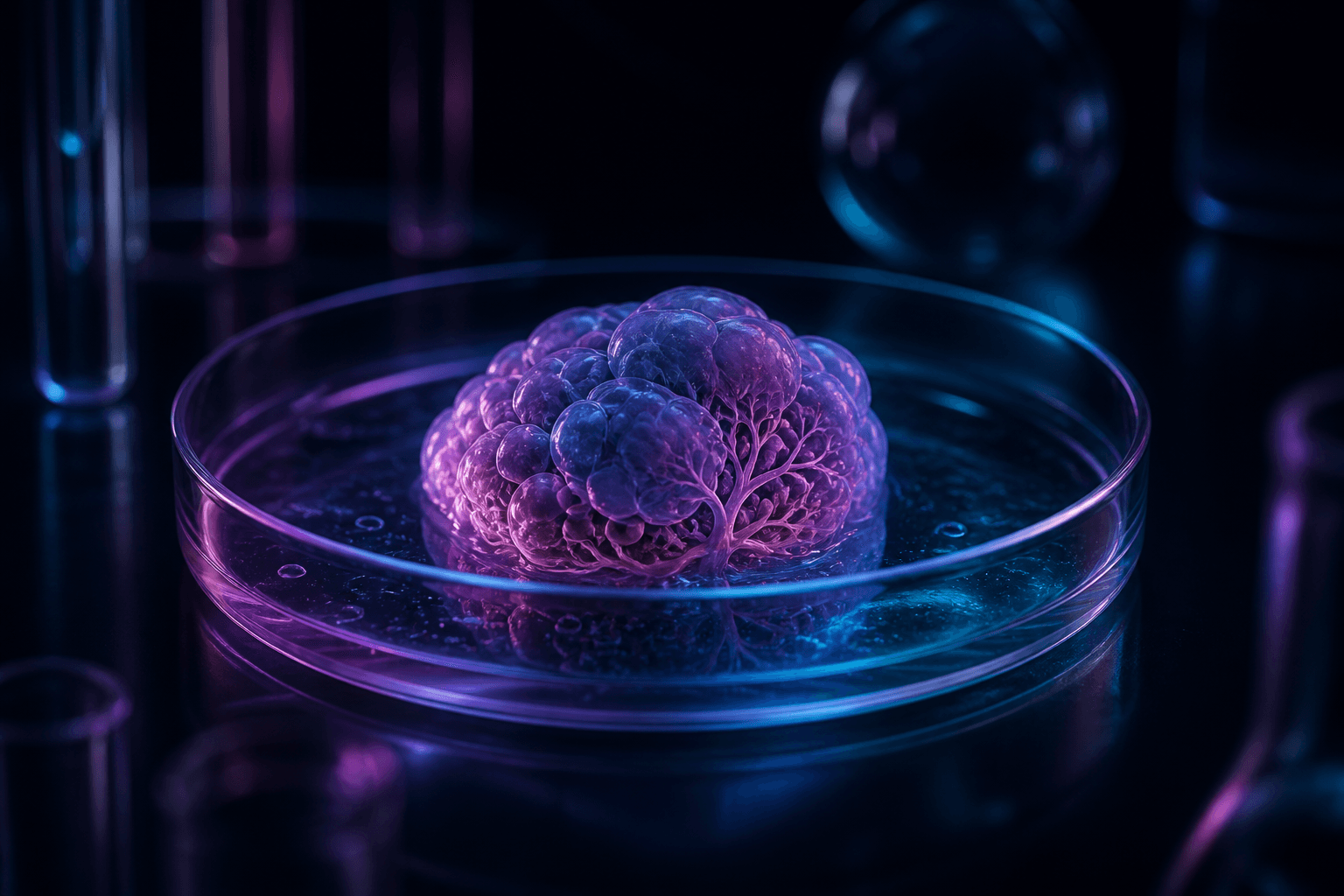
Organoids have been around for years
What's changing is the technology stack around them.
Developing a new medicine is, in many ways, an incredibly expensive process of finding out what doesn't work.
A drug candidate can spend years moving through experiments before researchers discover that it isn't effective enough, is too toxic, or simply behaves differently in humans than expected.
And the consequences of that failure extend beyond a wasted experiment.
It's the researchers designing the study. The technicians running it. The facilities, equipment and energy. The time spent collecting and analysing the results. Then all the work that follows if the drug continues further down the pipeline, and most importantly, the animals whose lives are part of that process.
More than 90% of drugs that clear animal testing still go on to fail in human trials.
That doesn't mean animal research is useless. It means there is an enormous gap between the model we're testing and the human we're ultimately trying to understand.
And technology is beginning to give researchers another way to close that gap.
So, what exactly is an organoid?
You don't need a biology degree to understand the basic idea.
An organoid is a small, three-dimensional piece of human tissue grown in a laboratory from stem cells or other human cells.
Researchers can grow organoids that reproduce some of the characteristics of organs such as the intestine, brain or heart. They can also create them from patient-derived cells, allowing researchers to retain some of the biological characteristics of a particular person.
They're not miniature organs in the sense that they can replace the real thing.
They're models.
But they're models made from human biology.
And that matters when you're trying to understand how human biology responds to a drug.
We've already got ways to predict this
This isn't about saying we currently know nothing about how patients respond to medicines.
We have genetic testing, medical history, clinical trials, pharmacology, drug-interaction databases and increasingly sophisticated computational models.
These can tell us a lot about who might respond to a treatment or be at higher risk of an adverse reaction.
An organoid gives researchers something different.
They can take human-derived tissue, expose it to a treatment and observe what happens.
It doesn't tell us exactly what will happen inside the whole person. An organoid doesn't have a complete circulatory system, immune system or all the interactions between organs.
But it can give researchers another piece of evidence that comes directly from human tissue.
And in drug development, better evidence earlier can be extremely valuable.
The real opportunity is failing sooner
This is where I think the economics become interesting.
Imagine spending years developing a drug, running experiments, using animals, employing researchers and investing millions of dollars, only to discover much later that the treatment doesn't work in humans.
Now imagine being able to rule out some of those candidates earlier.
That's the proposition behind these new models.
An organoid experiment isn't necessarily cheap. Growing, maintaining and validating these systems takes specialised equipment, expertise and time.
So the comparison isn't really: “Are organoids cheaper than mice?”
It is: “Can a more expensive experiment today prevent a much more expensive failure tomorrow?”
That is a very different question.
If a human-relevant model can help researchers identify ineffective or toxic drugs earlier, it could save not just money, but enormous amounts of researcher time, laboratory capacity and energy that would otherwise be spent pursuing a dead end.
The Cambridge team explicitly describes the potential in these terms: human-based models could improve the development of treatments while reducing the time and cost of developing new medicines.
That's where this becomes a technology story rather than simply a biology story.
But organoids aren't new
This is the part that initially made me pause.
Researchers have been growing organoids for more than a decade.
So why is a £20 million investment in 2026 interesting?
Because the important shift isn't inventing the organoid.
It's trying to make the technology usable at scale.
The new Cambridge hub, funded by the Medical Research Council, will work with researchers across the UK to develop a library of standardised and validated organoids that can be made available to academics and pharmaceutical companies.
That's a very different proposition from one research team successfully growing an organoid in a laboratory.
For an emerging technology to move into an industry, someone eventually has to solve the less exciting problems.
Can different researchers reproduce the same results?
Can companies trust the models?
Can results be compared across laboratories?
Can the technology integrate into existing drug-development workflows?
Can it be produced consistently enough to use at scale?
Those are infrastructure questions.
And infrastructure is often what determines whether a promising technology actually changes an industry.
We're not replacing the mouse
It would be easy to turn this into a story about scientists finally moving away from animal testing.
We're not there.
An organoid can't reproduce everything that happens inside a living organism. It doesn't capture the complete interaction between organs, circulation, metabolism and the immune system.
There are also practical limitations around growing, maintaining and standardising these models.
That's why the UK isn't betting on one replacement technology. Its broader strategy includes organoids, organ-on-chip systems and AI as part of a wider set of approaches to reduce reliance on animals.
The future is likely to be a combination.
Use the model that answers the question you actually have.
And then there's AI
This is where the technology stack gets even more interesting.
Imagine thousands of experiments involving different drugs, diseases and patient-derived tissues.
Every experiment generates data.
How did the tissue respond?
Which pathways changed?
Was there evidence of toxicity?
Did the disease characteristics improve?
Did one patient's tissue respond differently from another's?
At a certain scale, the challenge stops being generating data and becomes making sense of it.
That's where AI comes in.
The Cambridge hub is explicitly designed around combining stem-cell technology and AI with clinical research.
The organoid creates a more human-relevant experimental environment.
AI can help researchers analyse the enormous amount of information generated from those experiments and potentially identify patterns that would be difficult to find manually.
The interesting part isn't AI replacing the organoid.
It's the combination.
Better models can generate better data. Better data gives AI more to work with.
And that could create a feedback loop between biological experimentation and computational analysis.
The infrastructure is the story
This is what I find most interesting about the Cambridge investment.
We've had the underlying technology for years.
What's changing is the attempt to connect the pieces.
Human cells.
Organoids.
Clinical data.
AI.
Standardisation.
Pharmaceutical companies.
Research institutions.
The goal is to create a system where these aren't isolated experiments sitting in individual laboratories, but components of a larger drug-development infrastructure.
That's a much bigger technological shift.
The first organoid was an impressive scientific achievement.
A standardised network of human-based models that researchers and pharmaceutical companies can actually use repeatedly is something else entirely.
It changes the question from: “Can we do this?”
to: “Can we build a system around this?”
And that distinction shows up everywhere in technology.
The invention gets the attention.
The infrastructure determines whether it scales.
Humans inside the test tube
For a long time, we've had to learn about human biology through imperfect proxies: animals, cell cultures, population averages, computational models.
Each has its place.
But each creates some distance between the experiment and the person who will eventually receive the treatment.
Organoids don't eliminate that distance.
They give researchers another way to bring human biology into the experiment itself.
And if the technology becomes standardised enough to use at scale, the impact could extend well beyond reducing animal testing.
It could change how pharmaceutical companies decide which drugs are worth pursuing, how early they discover failures, how researchers study differences between patients, and how much biological data can be generated for AI to analyse.
That's why I think the interesting story isn't really the tiny organ.
It's the technology shift around it.
We're moving from building models of human biology to building experimental systems that increasingly incorporate human biology directly. And now we're starting to build the infrastructure to do it at scale.
Humans inside the test tube.